

The history and evolution of Tsumami Zaiku in Japan
The origins of Tsumami Zaiku
Tsumami-zaiku was born in the Edo period and was developed within the townspeople's culture during the Bunka-Bunsei period of the 1800s. However, in a broader sense, it is thought to have originated from "kanzashi" (hairpins), which were used as decorations for performing arts such as Kabuki, which is said to have begun in 1603 when the Edo Shogunate was established.
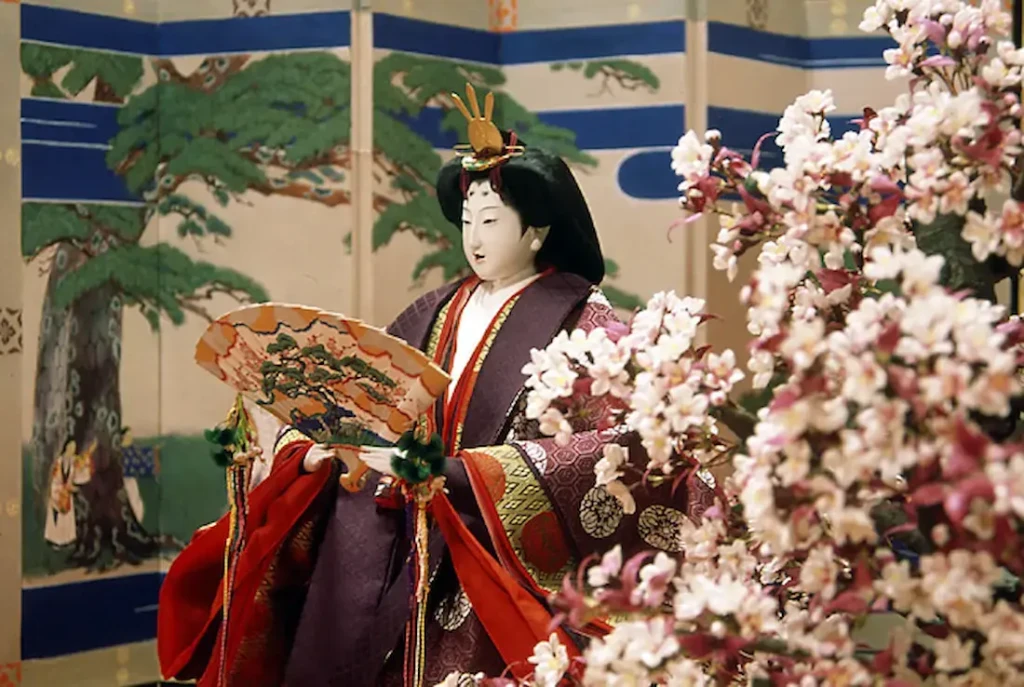
Tracing back further in history, we find that "Yusoku Zoka" (artificial flowers made from silk and Japanese paper) appear in documents from the mid-8th century, and are used to decorate events at the Imperial Court, suggesting that the origins of the tradition date back to around this time.
Please see here for the website of Oki Soju, one of the few professional flower makers in Japan, with whom Ichirindo has a relationship.
https://oki-suju.com/
Artistic Artificial Flower Artist Soju Oki's Homepage
From the flower hairpins worn by geisha to the popularization of tsumami zaiku
The commonly known "flower hairpins worn by maiko" are made with tsumami zaiku, and this is also said to have become common during the Bunka-Bunsei period of the Edo period.
After that, through the turning points of the era known as the Meiji Restoration and the Taisho Romance, Japan developed a unique culture while skillfully incorporating Western culture.
In the Showa era, and especially after the war, the custom of wearing kimonos and celebrating important milestones in life, such as the five seasonal festivals, with families became common.
In the past, it was common to have family photos taken at a local photo studio, but from around the 1970s, major kimono stores opened chains of clothing rental stores, and major photo studios also expanded nationwide, making celebrations like Shichi-Go-San and Coming of Age Day more familiar.
Along with this, tsumami zaiku also spread throughout the country, and was established as a specialized occupation within the hair accessory industry called "tsumami kanzashi craftsman."
During this period, a business called "wholesaler" supported the market as a distribution system unique to Japan, and during the economic boom, tsumami kanzashi craftsmen were able to earn a comfortable living by working for wholesalers.
Then, around 1990, known as the "bubble burst," the market itself underwent a dramatic change, and industries that primarily relied on handwork, such as traditional crafts, began to move overseas in search of cheap labor.
Due to this changing times, many craftsmen lost their jobs and were left without successors. Not only were industries that produced raw materials and tools forced to shift to other fields, but as a result, it became difficult to pass on traditional culture.
For reference, the number of births nationwide in 1980 was approximately 1.57 million, of which approximately 750,000 were girls, and since many of the children born that year celebrated Shichi-Go-San in some form in 1983 and 1987, it was a very large market. By 2020, however, the number of births had fallen to approximately 840,000, almost half of that number (see figures from the Statistics Bureau of the Ministry of Internal Affairs and Communications).

Masayuki Takahashi, founder of Tsumamido, the predecessor of Ichirindo
Masayuki Takahashi (deceased), the owner of the former Tsumamido, the predecessor of Ichirindo, was the second generation owner of a long-established ornament wholesaler in Asakusabashi. He experienced the history of these changes in the industry firsthand, and, believing that only the next generation could shape the industry in its later years, he also felt it was his responsibility to pass on the traditions, so he founded Tsumamido with the aim of passing on the traditional culture of tsumami-zaiku.
In order to properly pass on traditional crafts, I visited many artisans to ask for their help, but at the time I was constantly turned down, with people saying, "It's ridiculous to teach the general public skills that I wouldn't even teach my apprentices in exchange for a small amount of money!"
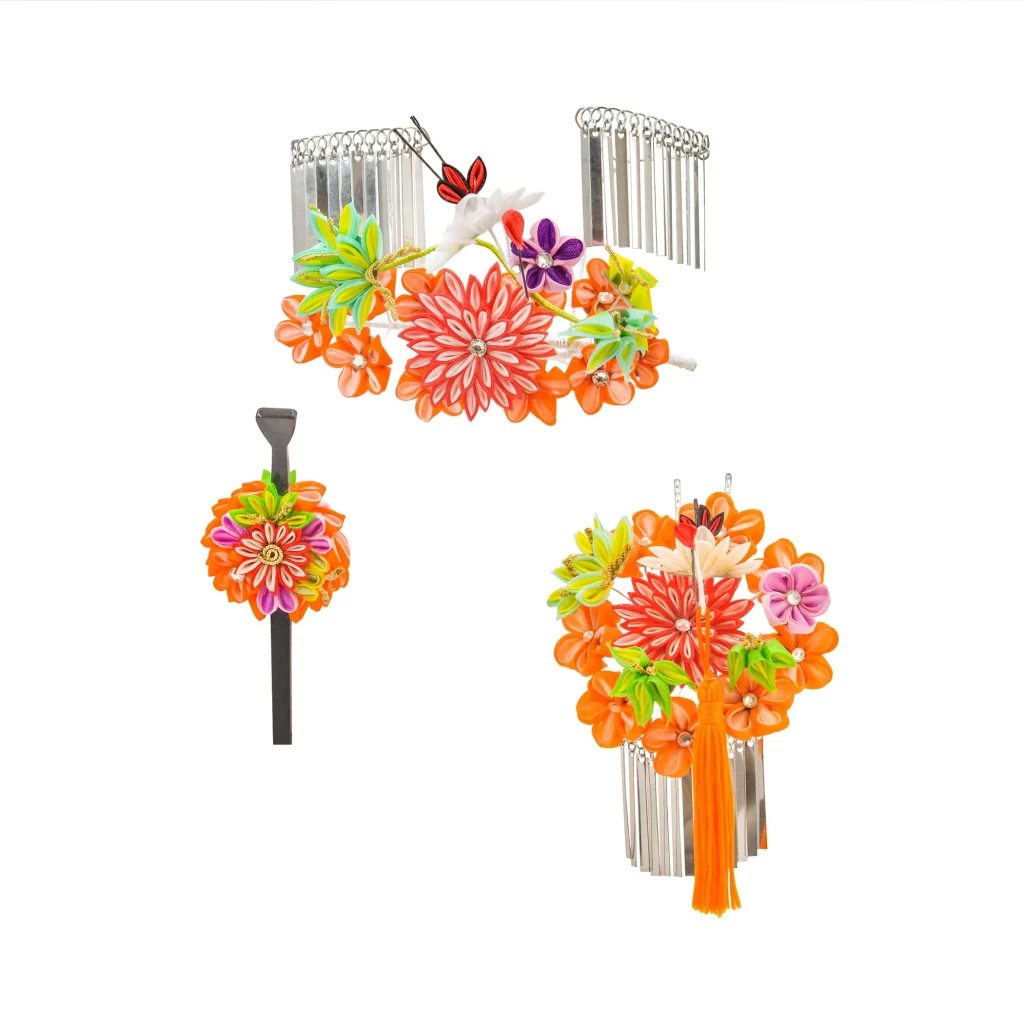
Flat Kanzashi 3-piece set by Tomura Kinuyo
During this time, he met Kinuyo Tomura, who had been an intangible cultural property holder of Arakawa Ward for two generations, and in response to her late husband's earnest request, a systematic tsumami zaiku course was opened by an active tsumami kanzashi artisan. This sparked a new need at the time, for people to make their own tsumami zaiku hair ornaments for their children or grandchildren's Shichi-Go-San celebrations, and this led to the current form of tsumami zaiku as a craft.
Important things to keep the tradition of Tsumami-zaiku alive
The decline in the number of craftsmen who make the costumes and accessories worn by professional performers in Kabuki, theater, and other performing arts cannot be stopped, and the number of production areas that produce materials and tools is also decreasing, so the issue of the decline of a traditional culture that has continued for 200 years remains unresolved.
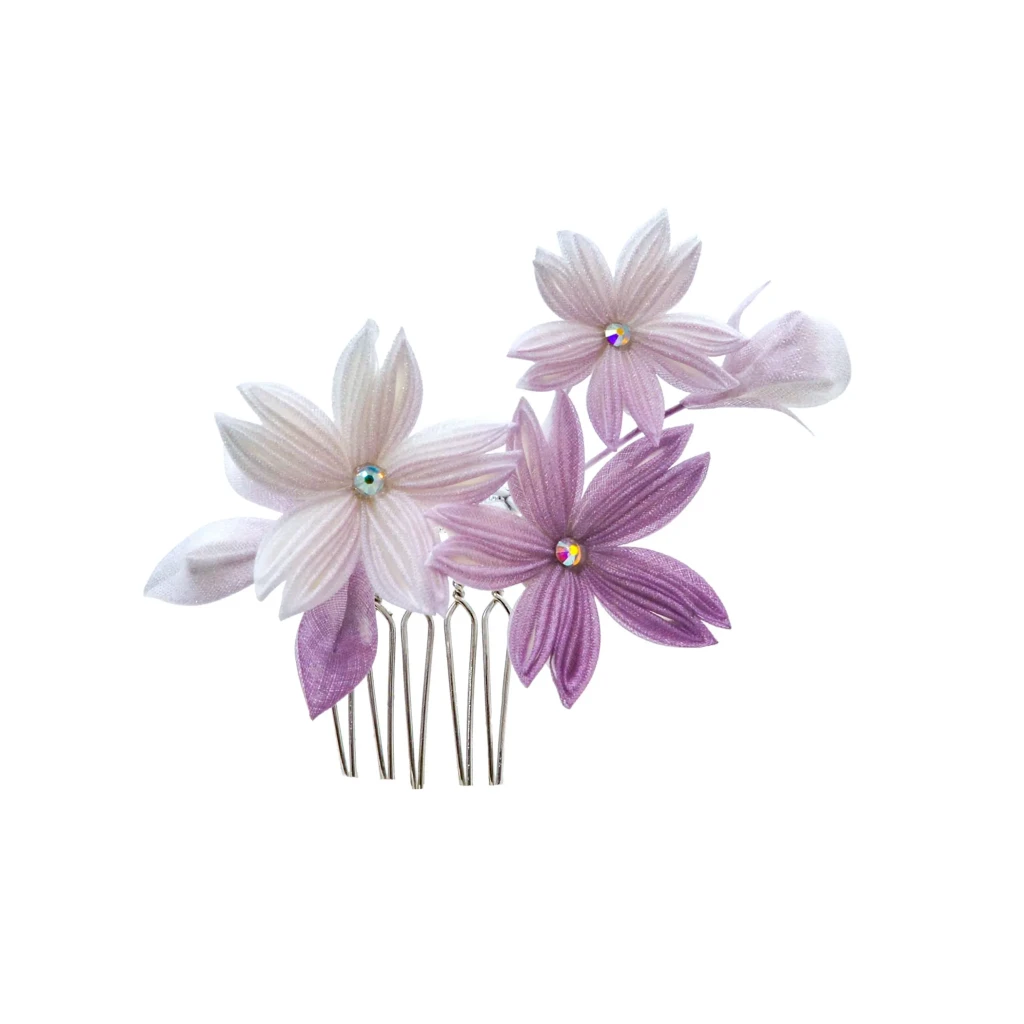
There is no doubt that how we can link tsumami zaiku as a craft with tsumami zaiku as a traditional craft will have a major impact on the next generation, but to achieve this we need the power of today's young people, and it is also important to reach out to children.
In our next blog post we will cover this topic.